Wednesday, 25 April 2012

A Community Spirit

The 1979 exhibition on St. John Ogilvie was the first in a series of documentary exhibitions and related publications produced by the Third Eye Centre on famous men and women in Glasgow’s history.   The exhibition concentrated on the life and times of the Scottish Saint and included reproduction documents, maps, models and portraits of key figures that featured in his life and subsequent canonisation in 1976. 

The exhibition involved contributions from local institutions including Aloysius College, The Mitchell Library and the Scottish Catholic Archives and produced an ambitious publication which included the first bibliography on Ogilvie.  

The archive material reveals that this exhibition was prepared and treated in the same way as any visual arts exhibition or event at the Third Eye Centre, and the breadth of participants communicated to in the files of correspondence highlight the curatorial vision of the Centre to engage with and educate social communities beyond visual art.  

Image from Irish Weekly and Ulster Examiner Vol. XCV No. 3092

The CCA now has an official Education and Outreach programme which takes an alternative approach  to working with people in Glasgow with initiatives such as ‘This Land is Your Land’.  Other Third Eye Centre  files recently cataloged  document the preparation of a similar gardening and allotment project called  ‘Dear Green Place’ as well as  ‘Garnethill Exhibition’ and ‘Modernisation by Inches’  which  observed and discussed Glasgow’s urban planning and communities.  All early evidence of  green shoots for the Third Eye Centre and CCA’s spirit for community investment and engagement. 


Wednesday, 18 April 2012

Glasgow Is International

As Glasgow’s art community frantically makes its final preparations for the launch later this week of the fifth edition of Glasgow International Festival of Visual Art, the material hidden in the boxes of the Third Eye Archive reveals a long standing heritage of drawing international art to Glasgow and promoting Scottish art beyond its borders.

Extracts from Directors reports c.1981-1984 highlight that The Third Eye Centre was Scotland’s most active touring agency during this period, and lists an extensive touring programme of exhibitions including ‘A Moment in Time: Scottish Contributions to Photography’ and the popular  ‘History of Scottish Football’.  The reports also comment on the development of international links through research trips resulting in exhibitions of Canadian, Hungarian and Aboriginal art. 

While these reports provide clear statistical evidence of Glasgow and The Third Eye Centre's links to international  creative activity, the real proof of its global ambitions are revealed in the pages of enthusiastic correspondence in French (or Franglais) between the then exhibitions officer Bridget Brown and Liliane Touraine, the curator of the Musical Graphics exhibition from the Mussee d’Art Moderne in Paris.  Musical Graphics  bought together visual imagery of musical scores alongside a performance programme and was the most comprehensive exhibition of its kind at the time with scores presented from John Cage to Mozart.

From these early days of attracting an international audience and artists to the city, Glasgow is well primed for the exciting events of the next two weeks...

Image Credit: The Third Eye Centre Archive

Thursday, 5 April 2012

"Glasgow's Official Photographer"


As I’ve been making headway through the one hundred and three boxes of Third Eye material, it would be easy to get so involved with the fascinating details of their contents and to forget the other strands of evidence that this project aims to explore if it were not for the strong links that exists between them.

The George & Cordelia Oliver Collection is a personal archive of an important art critic, commentator and collector that has been housed at the Glasgow School of Art since its donation by the late Cordelia Oliver in 2008.  Limited resources have dictated that no detailed research of this collection has been conducted and only an inventory has been produced.  While the material is safely kept here at GSA, it is an untapped source of narrative texture on Glasgow’s Art scene over a forty year period.  This project will for the first time begin to unearth some of its reflections, stories and images, as we index newspaper clippings, hand written notes and photographs by her husband George Oliver.

Rooting through and listing details of box twenty three, I was reminded of the compelling associations between the research strands upon finding a letter from a Director of The Third Eye Centre, Chris Carrell.  It was written in 1978 to George Oliver thanking him for some slides and confirming him as the “Third Eye Centre (Ltd) Glasgow’s official photographer” and goes on to discuss his monthly fees and rates.  

Much of the paperwork in these boxes might seem inconsequential upon first inspection, but the background details that a simple letter like this provides can strengthen and progress research and illuminate interweaving personal histories.

'Art And The Sea' 1981. Image Credit: The George & Cordelia Oliver Collection


Monday, 2 April 2012

Archive Observations

Last week the Glasgow Miracle’s Research Assistant and I visited sunny London to find out more about the work of the Whitechapel Gallery’s Archive and Cinenova. Many thanks to the individuals at these organisations who spent time talking to us!

We found it really useful to see how Whitechapel’s archives form a key part of the Gallery’s exhibition and education programme, encouraging reflection on past events and acting as a stimulus for new creativity. The Glasgow Miracle project hopes to organise a number of public activities utilising the archives we are working with. More details will be posted here as soon as they become available...

Cinenova work with women filmmakers to support the distribution of their work. In doing so, they also work closely with the users of this material. By establishing dialogue with and between film makers and film users, Cinenova are able to accrue more information about the films they work with and observe changing approaches to the perception and use of this material. We are also keen to establish a dialogue with people who were involved in the ‘making’ of activities related to The Third Eye Centre and CCA and/or who are interested in potentially using the Third Eye and CCA archives once they have been indexed.

Finally, this week’s image – a list of material (including archive items!) used by The Third Eye in an exhibition about Garnethill in 1976. The files show that this exhibition used a wide variety of artefacts and archives to explore Garnethill’s past and its present, confirming our belief
that archives can play a key role in cultural engagement.

Image Credit: Third Eye/CCA Archive

Thursday, 22 March 2012

One Hundred and Three Boxes

The purpose of this blog is to disseminate ‘highlights’ from the vast wealth of material that the project has procured, encompasses and will be producing via its four main strands of enquiry.

In terms of quantity, the largest of these strands of evidence is the archives of the Third Eye Centre and the Centre for Contemporary Art (CCA).  Comprising paperwork, photographs and ephemera from 1972, (prior to the inception of The Third Eye Centre), up to the current activities at the CCA as recently as 2011.  This nearly forty year period covers the highs and lows of contemporary art practice at 350 Sauchiehall Street, drawing in public, social and personal histories from Glasgow and beyond.

The prospect of cataloguing this rich and diverse material is as daunting and as problematic as it is exciting. Much of my time so far has been spent considering and discussing with my colleagues how to approach the arrangement, description and processing of the material in a manor that remains sensitive to its ideology and character, whilst making it a valid and useful tool for research.

Researching the approach of other art institutions to archiving  (IKON, Whitechapel, The John Latham Archive, Transmission etc) has revealed that there cannot, and probably should not, be a ‘one size fits all’ methodology for cataloguing creative content.  We have worked out a methodology which places emphasis on generating a comprehensive timeline of activities and a list of index terms rather than on arrangement and analysis. This fits in with the project’s wish open up the archives for the research and curiosity of others.  

Since establishing our cataloguing system, my daily process of sorting through the Third Eye boxes has become more accurate and efficient. In this week alone I have indexed twice the quantity of boxes that I had been through on the first month of the project.  From blueprint and preparations for the opening of The Third Eye Centre, photographs of the Gables End project, to personal correspondence between Jimmy Boyle and Tom McGrath; the last ten boxes I’ve sorted through are so rich in information and historic texture.  The thought of having to pick just one thing out from one box every week will not be easy, so this week I’ll cheat, and show you all one hundred and three boxes instead.

Image Credt: Carrie Skinner

Monday, 12 March 2012

“It can only work if you are prepared to get involved”

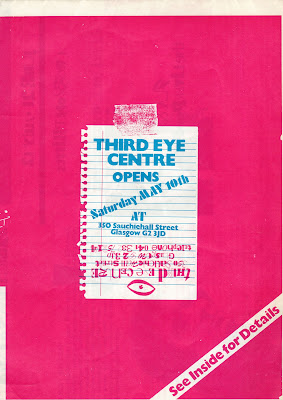
Just eight weeks into this eighteen month project and we are already unearthing some long forgotten artefacts that will help to build up and fill gaps in our collective knowledge and memories of the CCA’s heritage and it's predecessor The Third Eye Centre.

Image Credit: The Third Eye Centre
This cover page comes from an introductory newspaper launching The Third Eye Centre’s inaugural programme over thirty-five years ago in 1975, and it was kindly donated by someone who had heard of the project through a recent newspaper article.  Although we already have stacks of boxes to trawl through and sort, this was a very welcome addition.  Being just a twinkle in my father’s eye in 75’, I am particularly aware that it is the contribution of others through such simple donations or recollections that have the capacity to be the most valuable asset in the projects development.

We are not aiming to write a definitive history of this period. Rather we aim to organise and index, to provide easier access to a spectrum of materials that will provide a starting point for a variety of potential histories.  We hope this will further specialist research and general debate on the subject of contemporary art in Glasgow and beyond, to help ensure Glasgow remains a creative centre with the right conditions for artistic practice. 

Through this blog you will be able to track our progress as we disseminate information about project activities, with posts from all the team involved.  By drawing out ‘highlights’ from the material, we hope to solicit personal reflections and request input from those who may be able to answer some of the many questions the material is already throwing up!

Inviting Glasgow to it’s opening, the founders of the Third Eye Centre wrote of a gallery and programme prepared, “waiting for the one essential ingredient in the whole project – YOU”.  Echoing their sentiment, keep an eye on us and get in touch, whoever you are, with whatever you have to say and share, “It can only work if you are prepared to get involved”.